Saturday, August 6, 2011

Type of Manga

Manga


Josei Manga


If You Totally
Love
 
Josei manga (女性?, lit. "woman", pronounced [dʑosei]), also known as "ladies" (レディース redīsu?) or "ladies' comics" (レディコミ redikomi?, lit. "LadyComi"), is a term that refers to the target demographic of manga created mostly by women for late teenage and adult female audiences. Readers range from 15-44. In Japanese, the word josei means simply "female" and has no manga-related connotations at all.
The stories tend to be about everyday experiences of women living in Japan. Though there are some that cover high school, most cover the lives of adult women. The style also tends to be a more restrained, realistic version of shōjo manga, keeping some of the wispy features and getting rid of the very large sparkly eyes. There are exceptions in the style described above, but what defines josei is some degree of stylistic continuity of comics within this particular demographic (the same is true with different demographics that have different stylistic tendencies).


Josei comics can portray realistic romance, as opposed to the mostly idealized romance of shōjo manga, but it does not always have to be. A famous example of a josei is Honey and Clover, which was animated, which is unusual for josei comics.[original research?] Josei tends to be both more sexually explicit and contain more mature storytelling, although that is not always true either. It is also not unusual for themes such as NTR and rape to occur in josei manga target specifically towards more mature audiences. Some other famously popular josei series include Yun Kouga's Loveless, Ai Yazawa's Paradise Kiss, and the award-winning works of Erica Sakurazawa.


more...


Shonen Manga

BLEACH
Shōnen (少年?), shonen, or shounen, is a Kanji word literally meaning few years and generally referring to a typical boy, from elementary school through grade school age. It is used in everyday conversation when referring to the period of youth, including in legal wording referencing youth, without regard to gender. Shōnen manga is a popular genre of Japanese comics, generally about action/fighting but often contains a sense of humor and strong growing friendship-bonds between the characters.


According to Japanese law, the term "shonen" refers to "a person from the time they enter elementary school until the time they are 15 years of age" , and "Any person who has not reached the age of 15 years" 
 more...


Seinen Manga


My Sweet Kaicho
Seinen manga (青年漫画?) is a subset of manga that is generally targeted at a 20–30 year old male audience, but the audience can be older with some comics aimed at businessmen well into their 40s. In Japanese, the word Seinen means "young man" or "young men" and is not suggestive of sexual matters. The female equivalent to seinen manga is josei manga. It has a wide variety of art styles and more variation in subject matter, ranging from the avant-garde to the pornographic. Seinen manga is distinguished from shōnen, or boys' manga, by having a stronger emphasis on realism. Because of the emphasis on storyline and character development instead of action, some seinen series are often confused with shōjo, or girls' manga.[citation needed] This is especially true of seinen comedy series such as Chobits, and Chi's sweet home, or seinen drama such as Twin Spica. Other examples of seinen manga include: Gantz, Battle Royale, 20th Century Boys, Monster, Blame!, Ghost in the Shell, Akira, Berserk, Battle Angel Alita, Hellsing, Drifters, Neon Genesis Evangelion, and Elfen Lied. Rumiko Takahashi's Maison Ikkoku is sometimes classified as seinen, although this is disputed by some fans.


A common way to tell if a manga is seinen is by looking at whether or not furigana is used over the original kanji text: if there are furigana on all kanji, the title is generally aimed at a younger audience. The title of the magazine it was published in is also an important indicator. Usually Japanese manga magazines with the word "young" in the title (Young Jump for instance) are seinen. Other popular seinen manga magazines include Ultra Jump, Afternoon, and Big Comic.


more...


Shojo Manga


Ouran High School
Host Club
The term shōjo, shojo, or shoujo manga (少女漫画 shōjo manga?) refers to manga marketed to a female audience roughly between the ages of 10 and 18. The name romanizes the Japanese 少女 (shōjo), literally: "little female". Shōjo manga covers many subjects in a variety of narrative and graphic styles, from historical drama, to boys' love, to science fiction — often with a strong focus on human and romantic relationships and emotions. Strictly speaking, shōjo manga does not comprise a style or a genre per se, but rather indicates a target demographic. Examples include Ouran High School Host Club, Fruits Basket, Fushigi Yuugi, Sailor Moon, Vampire Knight, Romeo x Juliet, Princess Ai and Tokyo Mew Mew.


more...

Thursday, August 4, 2011

The History


Manga

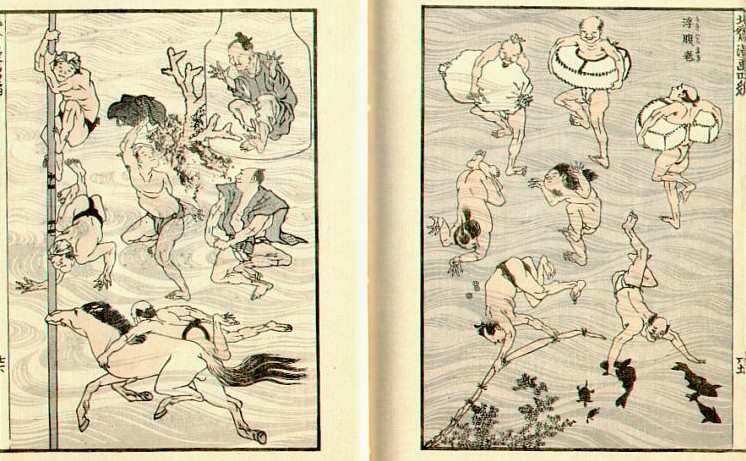
Image of bathers from the Hokusai manga
The History of manga originates from scrolls dating back to the 12th century[dubious – discuss], however whether these scrolls are actually manga is still disputed, though its believed they represent the basis for the right-to-left reading style. Other authors report origins closer to the 18th century. Manga is a Japanese term that generally means "comics" or "cartoon", literally "whimsical sketches." Historians and writers on manga history have described two broad and complementary processes shaping modern manga. Their views differ in the relative importance they attribute to the role of cultural and historical events following World War II versus the role of pre-War, Meiji, and pre-Meiji Japanese culture and art.
The first view emphasizes events occurring during and after the U.S. Occupation of Japan (1945–1952), and stresses that manga was strongly shaped by United States cultural influences, including U.S. comics brought to Japan by the GIs and by images and themes from U.S. television, film, andcartoons (especially Disney). According to Sharon Kinsella, the booming post-war Japanese publishing industry helped create a consumer-oriented society in which publishing giants like Kodansha could shape popular taste.


Anime

A cell from the earliest known
Anime short from 1917.
Anime began at the start of the 20th century, when Japanese filmmakers experimented with the animation techniques also pioneered in France, Germany, the United States, and Russia. The oldest known anime in existence first screened in 1917 – a two-minute clip of a samurai trying to test a new sword on his target, only to suffer defeat. Early pioneers included Shimokawa Oten, Jun'ichi Kouchi, and Seitarō Kitayama.
By the 1930s animation became an alternative format of storytelling to the live-action industry in Japan. But it suffered competition from foreign producers and many animators, such as Noburō Ōfuji and Yasuji Murata still worked in cheaper cutout not cel animation, although with masterful results. Other creators, such as Kenzō Masaoka and Mitsuyo Seo, nonetheless made great strides in animation technique, especially with increasing help from a government using animation in education and propaganda. 
Screenshot from
Momotaro's Divine Sea Warriors (1944),
the first feature-lengthanime film


The first talkie anime was Chikara to Onna no Yo no Naka, produced by Masaoka in 1933. The first feature length animated film was Momotaro's Divine Sea Warriors directed by Seo in 1945 with sponsorship by the Imperial Japanese Navy.
The success of The Walt Disney Company's 1937 feature film Snow White and the Seven Dwarfs influenced Japanese animators. In the 1960s, manga artist and animator Osamu Tezuka adapted and simplified many Disney animation-techniques to reduce costs and to limit the number of frames in productions. He intended this as a temporary measure to allow him to produce material on a tight schedule with inexperienced animation-staff.
The 1970s saw a surge of growth in the popularity of manga – many of them later animated. The work of Osamu Tezuka drew particular attention: he has been called a "legend" and the "god of manga". His work – and that of other pioneers in the field – inspired characteristics and genres that remain fundamental elements of anime today. The giant robot genre (known as "Mecha" outside Japan), for instance, took shape under Tezuka, developed into the Super Robot genre under Go Nagaiand others, and was revolutionized at the end of the decade by Yoshiyuki Tomino who developed the Real Robot genre. Robot anime like the Gundam and The Super Dimension Fortress Macross series became instant classics in the 1980s, and the robot genre of anime is still one of the most common in Japan and worldwide today. In the 1980s, anime became more accepted in the mainstream in Japan (although less than manga), and experienced a boom in production. Following a few successful adaptations of anime in overseas markets in the 1980s, anime gained increased acceptance in those markets in the 1990s and even more at the turn of the 21st century.

Wednesday, August 3, 2011

What are Anime and Manga?


K-ON!

Anime (アニメ) refers to the animation style originated in Japan. It is characterized by distinctive characters and backgrounds (hand-drawn or computer-generated) that visually and thematically set it apart from other forms of animation. Storylines may include a variety of fictional or historical characters, events, and settings. Anime is aimed at a broad range of audiences and consequently, a given series may have aspects of a range of genres. Anime is most frequently broadcast on television or sold on DVDs either after their broadcast run or directly as original video animation (OVA). Console and computer games sometimes also feature segments or scenes that can be considered anime.

Hayate The Combat Butler
Manga (漫画) is Japanese for "comics" or "whimsical images". Manga developed from a mixture of ukiyo-e and Western styles of drawing, and took its current form shortly after World War II. Manga, apart from covers, is usually published in black and white but it is common to find introductions to chapters to be in color, and is read from up to down and then right to left, similar to the layout of a Japanese plain text. Financially, manga represented in 2005 a market of ¥24 billion in Japan and one of $180 million in the United States. Manga was the fastest growing segment of books in the United States in 2005.

Anime and manga share many characteristics, including: exaggerating (in terms of scale) of physical features, to which the reader presumably should pay most attention (best known being "large eyes"), "dramatically shaped speech bubbles, speed lines and onomatopoeic, exclamatory typography..." Some manga, a small amount of the total output, is adapted into anime, often with the collaboration of the original author. Computer games can also give rise to anime. In such cases, the stories are often compressed and modified to fit the format and appeal to a wider market. Popular anime franchises sometimes include full-length feature films, and some have been adapted into live-action films and television programs.

Wikipedia.org